

Wedding Photography Tips & Tricks for Perfectly Captured Memories
Embracing the Cinematic, the Authentic, and the Beautifully Unscripted
Most people think “perfect” wedding photography is just a fancy way of saying “blurry backgrounds,” expensive filters, and impeccably staged poses. We have been conditioned by glossy magazines and curated social media feeds to believe that a wedding day is a theatrical production, requiring absolute perfection at every turn. But to me, it’s so much deeper—and far more interesting—than that. Your wedding isn’t a checklist of events to be ticked off, nor is it a sterile fashion photoshoot; it’s a living, breathing narrative. It’s a story full of joyful chaos, quiet glances, fleeting emotions, and unpredictable weather.
My approach to wedding photography is simple, though executing it requires absolute focus: be present, be curious, be playful, and above all, let the day unfold naturally. The absolute best photographs aren’t meticulously staged by a loud photographer barking orders—they are discovered by a quiet observer who is paying close attention.
Whether you are a couple currently navigating the overwhelming world of planning your big day, or a fellow photographer looking to strip back the artifice and lean into a more relaxed, documentary style, I want to share my philosophy. Here is a deep dive into my golden rules for perfectly capturing the authentic, cinematic memories of a wedding day.
1. The Art of Invisibility: Forget the Camera Exists
The most powerfully “cinematic” moments happen when you are completely unaware that you are being observed. As soon as someone knows a camera is pointed at them, their posture changes, their smile stiffens, and the authenticity of the moment evaporates. As a documentary photographer, my job is to be attuned, to listen, and to observe—not to orchestrate.
For the Photographer: Achieving this invisibility isn’t about hiding in the bushes with a massive telephoto lens. Counterintuitively, it’s about being right in the middle of the action, but carrying yourself with a calm, unassuming energy. I use smaller, unobtrusive camera bodies and prime lenses. This allows me to move quickly, quietly, and closely among the guests without looking like a member of the paparazzi. I want the guests to view me as just another friend at the wedding who happens to have a camera. By establishing trust early in the day, people drop their guard.
For the Couple: The best advice I can give you for your wedding day is to completely surrender to the experience. Keep your eyes on each other, laugh at the inevitable mistakes (because things will go off schedule), and let the day breathe. If you are constantly looking for the camera, you aren’t looking at your new spouse, your family, or your friends. Trust the professional you hired to do the heavy lifting. The more you ignore the lens, the more raw, genuine, and intensely alive your final gallery will feel. Give yourself permission to feel every emotion without worrying about what your face looks like.
2. Chasing the “Difficult” Light (and Embracing the Shadows)
There is a strange obsession in the wedding industry with bright, airy, and evenly lit photographs. While there is a time and a place for that, it often strips a scene of its natural atmosphere. Instead of immediately reaching for a bright, distracting flash that completely kills the mood of a softly lit room, I prefer to use and manipulate the existing, natural light.
Mastering Chiaroscuro: Don’t be afraid of the dark corners of a venue. Playing with the interplay between natural light and deep shadows—a technique borrowed from classical painting called chiaroscuro—creates incredible depth, drama, and mood. It transforms a standard photograph into a cinematic frame. I am always looking for directional light. This might be the harsh, geometric streaks of sunlight pouring through the massive industrial windows of a venue like The West Mill, or the soft, fading twilight illuminating a couple standing in a dimly lit courtyard.
Letting the Environment Dictate the Shot: If a room is dark and moody, the photographs should reflect that dark, moody atmosphere. Pumping a room full of artificial strobe light might make the image technically “perfect,” but it destroys the memory of how that room actually felt.
Furthermore, “perfectly polished” is incredibly boring. In the pursuit of atmosphere, I am never afraid of pushing my cameras to the limit, which often introduces digital noise or grain. In cinema, film grain adds texture and emotion. A grainy, slightly blurred black-and-white photograph of a couple holding each other tight in a dimly lit room will always evoke more emotion than a clinically sharp, perfectly exposed, but utterly soulless portrait. I will always choose “perfectly atmospheric” over artificially flawless.
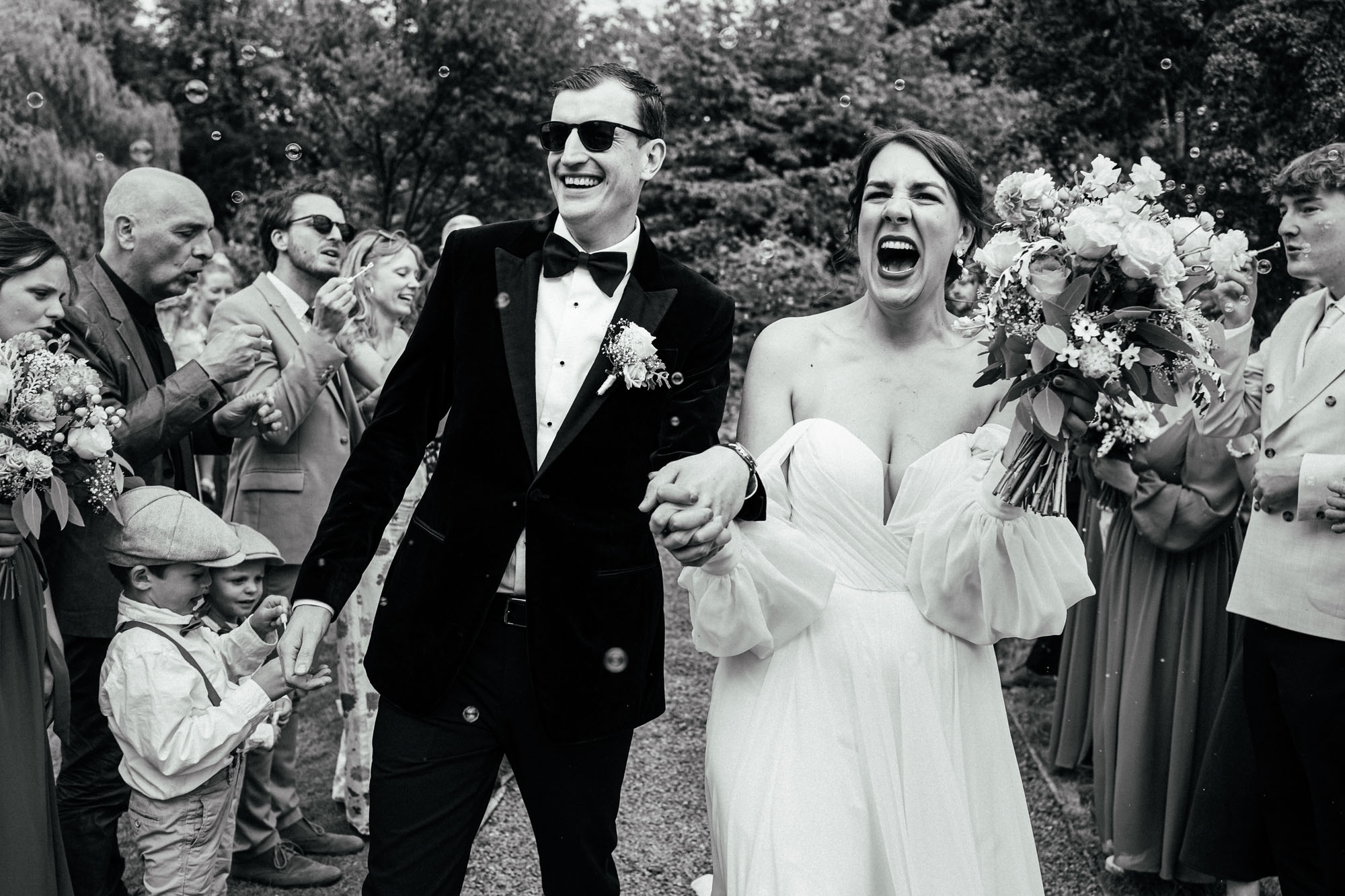
3. Cinematic Motion: Movement is Everything
Static is boring. When people are forced to stand perfectly still and hold a pose, they look like mannequins. In cinema, motion creates energy, narrative pacing, and emotion, and the exact same principle applies to wedding photography.
Directing Without Posing: During the portrait session of the day, I rarely tell a couple to simply stand there and smile. Instead, I give them actions. I ask them to walk toward me, to run away, to practice their first dance, or to just walk together and talk about their favorite part of the day so far. Movement forces you to stop thinking about your posture. A slightly blurred shot of a bride laughing mid-stride as the wind catches her veil, or the chaotic, blurred movement of the dance floor at 11 PM, will always be infinitely more “cinematic” than a perfectly sharp, static pose.
Making “Verb” Images: When thinking about composing a shot, focus on adjectives and verbs. Don’t just make “noun” images. A “noun” image is just a record of a thing: “Bride standing in nice light.” “Cake on a table.” “Groomsmen in a row.” Instead, strive to create “verb” images. Make them rich and descriptive, filled with action, reaction, and narrative in a single frame. “Bride throwing her head back in laughter as the wind catches her dress.” “Groom nervously tapping his fingers against his watch.” “Grandmother wiping away a tear while watching the ceremony.” Motion and action are the lifeblood of a documentary gallery.
4. The Symphony of the “In-Between” Moments
Traditional wedding photography puts all of its focus on the major milestones: the walk down the aisle, the first kiss, the signing of the register, the cutting of the cake. While these are obviously important records of the day, they are often the least interesting photographs. Real, compelling storytelling happens in the “in-between moments.”
Finding the Narrative in the Margins: It’s the nervous, solitary deep breath a groom takes before the venue doors open. It’s the chaotic, hilarious hour of trying to steam a dress and locate missing earrings in the bridal suite. It’s the unexpected burst of laughter from a grandparent reacting to a joke during the speeches, or the way a flower girl decides to sit on the floor in the middle of the ceremony.
These are the off-beat, unscripted moments that bring you right back to what you were experiencing at that exact second. As a photographer, this means you can never really put your camera down. You must anticipate the action. When the couple kisses at the altar, the traditional photographer gets the shot and lowers their camera. The documentary photographer gets the kiss, but keeps the camera glued to their eye to capture the immediate aftermath—the joyful exhale, the private whisper, the triumphant look exchanged between the couple as they realize they are finally married.

5. Layering Your Photos: The “Street Photography” Influence
Good composition is always a storytelling exercise, not just a way to make a picture look pretty. I draw a massive amount of inspiration from street photography and bring that raw, observational influence to weddings. A wedding is essentially a beautifully dressed street scene—full of converging storylines, chaotic environments, and fleeting interactions.
The Power of the “Dirty Frame”: One of my absolute favorite techniques is layering—shooting through things to create depth. I will often position myself so that I am shooting through a slightly opened doorway, past the shoulders of a crowd of guests, or through the leaves of a floral arrangement. This creates what is known as a “dirty frame,” where the foreground is often out of focus and enigmatic, framing the main subject in the distance.
Why do this? Because it gives the viewer the distinct feeling of being a hidden observer. It makes the photos feel truly candid, voyeuristic, and discovered, rather than manufactured. It adds a layer of mystery to the image.
Finding Geometry in the Chaos: In addition to layering, I am always looking for geometry and leading lines within the architecture of the venue. A sweeping staircase, a row of towering pillars, or dramatic negative space on a blank wall can make a quiet, intimate moment between a couple feel completely epic in scale.
Wide and Tight: A strong cinematic gallery relies on pacing. You have to balance the wide shots with the tight details. Try to capture the sweeping, wide “establishing shots” that show the entire landscape and set the scene of the venue. Then, juxtapose those grand images with incredibly tight, intimate macro shots: a hand resting gently on a shoulder, the muddy hem of a wedding dress after a walk through a field, or a pair of discarded high heels under a table. This shifting of perspective keeps the visual narrative engaging from the first image to the last.
The Takeaway: Feeling Over Perfection
Ultimately, capturing perfect memories isn’t about bringing a rigid, uniform formula to every single wedding. If a photographer shoots every wedding exactly the same way, using the exact same poses and the exact same lighting setups, they aren’t capturing your story—they are just inserting you into theirs.
True documentary wedding photography is about seeing past the pretty, superficial details so your memories will be firmly rooted in the atmosphere, the feelings, and of course, all the love that surrounded you.
Ditch the awkward poses. Ignore the pressure to host a “perfect” event. Focus entirely on the narrative flow of your day. Let the natural light, the unique architecture of your space, your individual personalities, and your unscripted story dictate the images. If you do this—and if you trust your photographer to do the same—you will end up with a collection of photographs that don’t just show what your wedding day looked like, but will forever remind you exactly how it felt.
Documentary Wedding Photographer
Tired of seeing the same old wedding photos?
My couples tell me things like “We didn’t know you were there“, “The photos are totally us” and “Everytime we look through the photos we see something new”.
If you want that sort of magic from your wedding photography – download the brochure to find out more about how I work and have instant access to pricing and packages.