
Bokeh Is Lying To You
Every wedding photographer you’ll ever meet owns an f/1.4 lens. Probably an 85mm. And they will use it to melt the background of your wedding day into a creamy, dreamy blur — and then hand you a gallery where everything looks beautiful and nothing looks like anywhere you’ve ever been.
I own that lens. I just leave it in the bag a lot.
The most dishonest thing in photography has a beautiful name
Bokeh. From the Japanese for blur, haze, or — my favourite translation — mental haze. Which is fitting, because that’s exactly what it produces. A kind of pleasant, expensive-looking amnesia.
It became the shorthand for “professional photographer” somewhere around 2010 and it’s never really let go. You’ve seen it ten thousand times. Sharp face. Blurred everything else. The background reduced to soft coloured circles, like someone sat on a packet of Skittles. It looks polished. It looks premium. And it is, quietly, an act of deletion.
Here’s the thing about shallow depth of field that nobody really talks about. It’s not neutral. It’s not just an aesthetic choice, like going black and white or adding grain. It’s a choice about how much of reality you want to keep.
And what it keeps is the subject. What it removes is everything else.
What I mean by adjectives
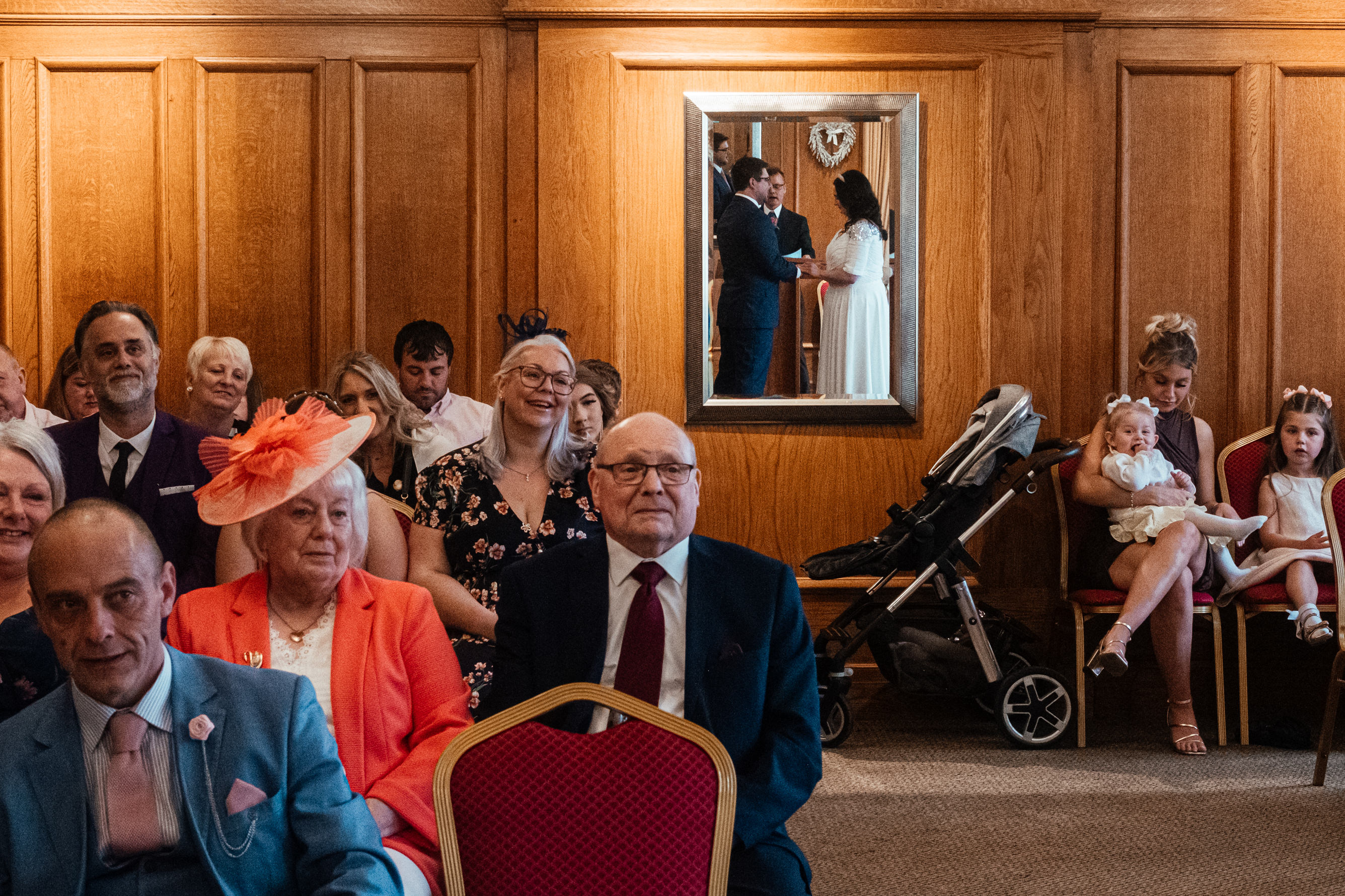
In writing, adjectives give you context. They’re the specific, particular details that turn a generic scene into a place. “A room” tells you nothing. “A low-ceilinged function room with fairy lights stapled slightly crookedly to the ceiling tiles, three generations of the same family wedged around a table that’s a bit too small, and a hand-drawn seating chart that someone has clearly had to revise twice” — that’s a wedding. That belongs to specific human beings on a specific day that will never happen again.
When you blur the background, you get “a room.” You get a beautiful, technically accomplished, completely interchangeable “a room.” The kind of image that could be any couple, any venue, any wedding. The kind of image that looks lovely on a photographer’s Instagram and tells you absolutely nothing about the people in it.
I’m not interested in “a room.”
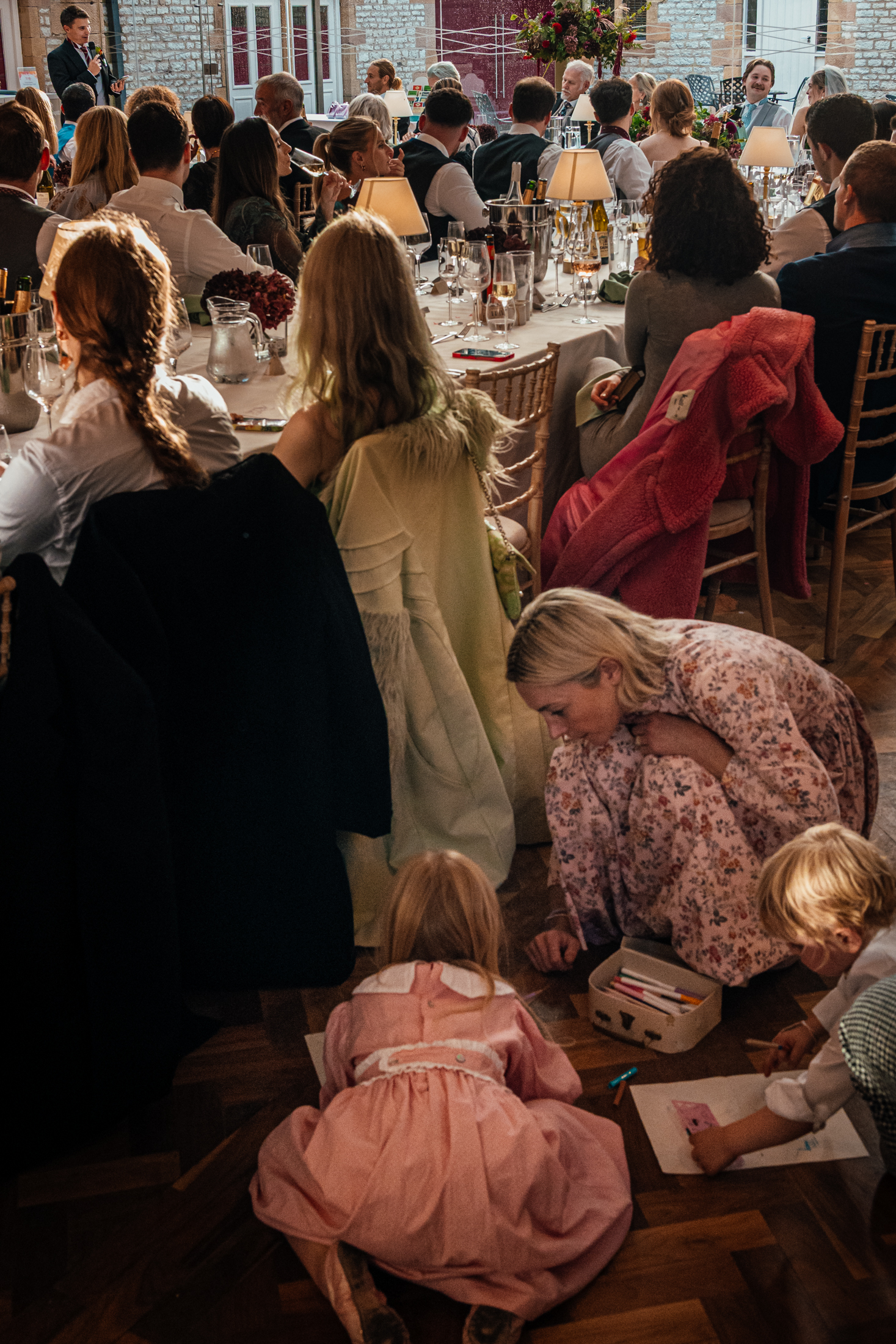
My whole approach is about keeping the adjectives in. Shooting stopped down, letting the venue and the organised chaos of the day exist in the frame as context — not as distraction. The flower girl losing her mind behind the couple during the ceremony is the story. The slightly-stressed mother of the bride checking her phone during the speeches is the story. The light coming off the canal through the industrial windows, the crookedly-hung bunting, the uncle already asleep in the corner at 4pm — all of it is the story.
When I’m framing a shot, I’m not asking “how do I isolate this moment?” I’m asking “what is this moment part of?” Those are completely different questions. They lead to completely different photographs.
The cinema comparison that nobody makes
Here’s something I think about a lot. The photographers whose work I love — Alex Webb, Matt Stuart, the great street documentary tradition — they’re obsessed with the full frame. Every corner matters. Every layer earns its place.
But you don’t even need to go to photography. Think about the films you remember.
Kubrick didn’t shoot wide open. Wes Anderson doesn’t shoot wide open. The Godfather’s cinematographer Gordon Willis — known, brilliantly, as “The Prince of Darkness” — was famous for adding visual information to the frame, not removing it. The layering of a Coppola scene, where three things are happening at different depths and the meaning lives in the relationship between them — that’s not an accident. That’s a philosophy.
When cinematographers want you to feel something, they don’t strip the frame bare and put a nice blur behind the actor’s head. They build the frame. They think about what the background says about the foreground. They use the whole image.
Wedding photography decided that the route to emotion was simplification. I think it went wrong there.
The darkroom is where the rest of the story disappears
So let’s say you’ve got a photographer who shoots wide. Good. They kept the adjectives in. But then they go home and spend three days in Lightroom and Photoshop removing them one by one.
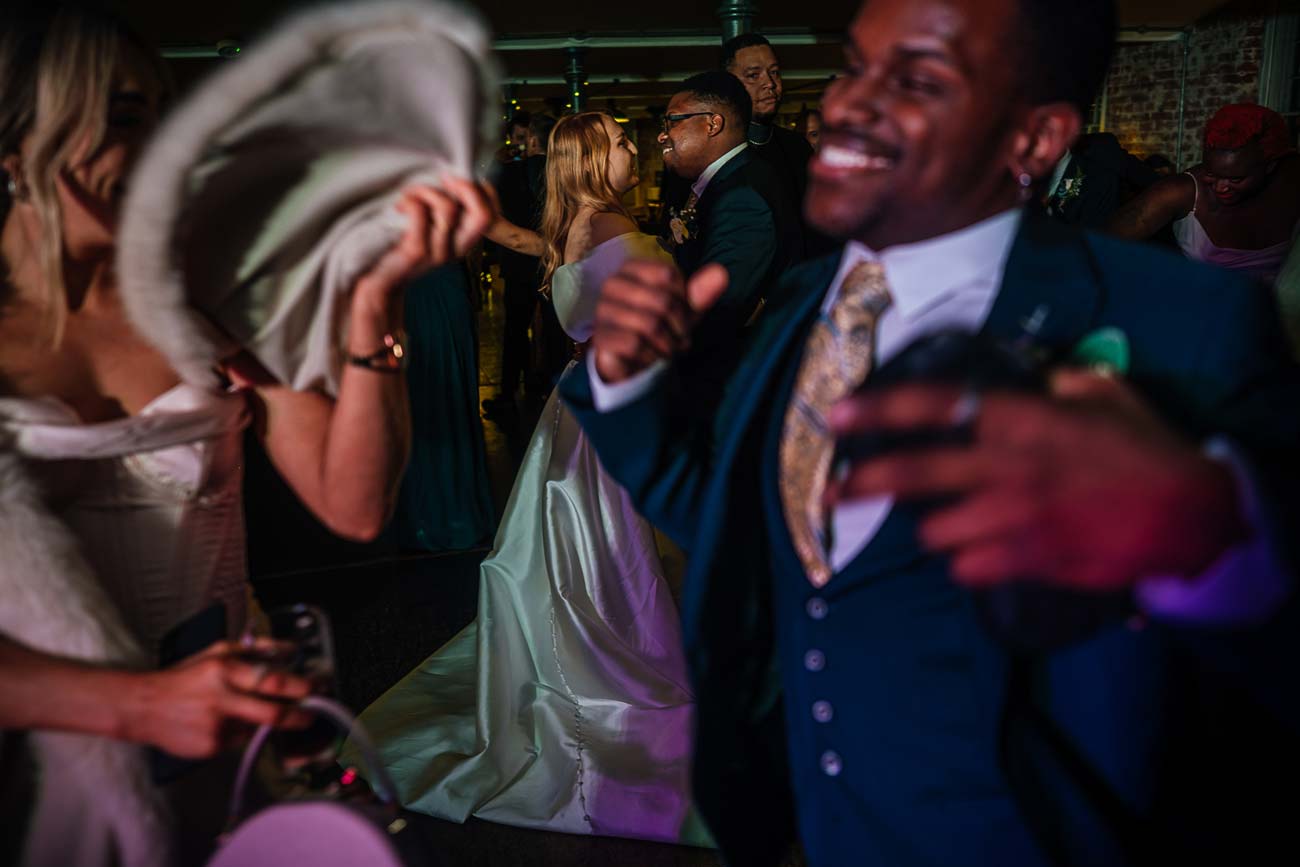
Dodge the shadows to lift the mood. Burn the edges to draw the eye. Clone out the empty glass, the stray handbag, the bit of scaffolding visible through the window. Content-aware fill over the guest who wandered into the back of the portrait. Clean it up. Smooth it out. Make it magazine-ready.
And what you end up with is — again — “a room.” A nicer room than the bokeh version, maybe. More detailed. But just as fictionalised.
I’m not immune to the impulse. There’s always a version of every image that would look better if I removed the thing in the corner. Cleaner. More composed. The kind of image that wins awards and gets pinned on Pinterest boards. And sometimes — when something is genuinely distracting and adds nothing — I’ll take it out.
But mostly I leave it. Because that empty glass means something. That stray handbag belongs to someone. The history of the room is in the scuffs and the imperfect light and the slightly wilting centrepiece at 9pm that was pristine at 2. That’s not mess. That’s time passing. That’s a day that actually happened.
The photos that keep giving
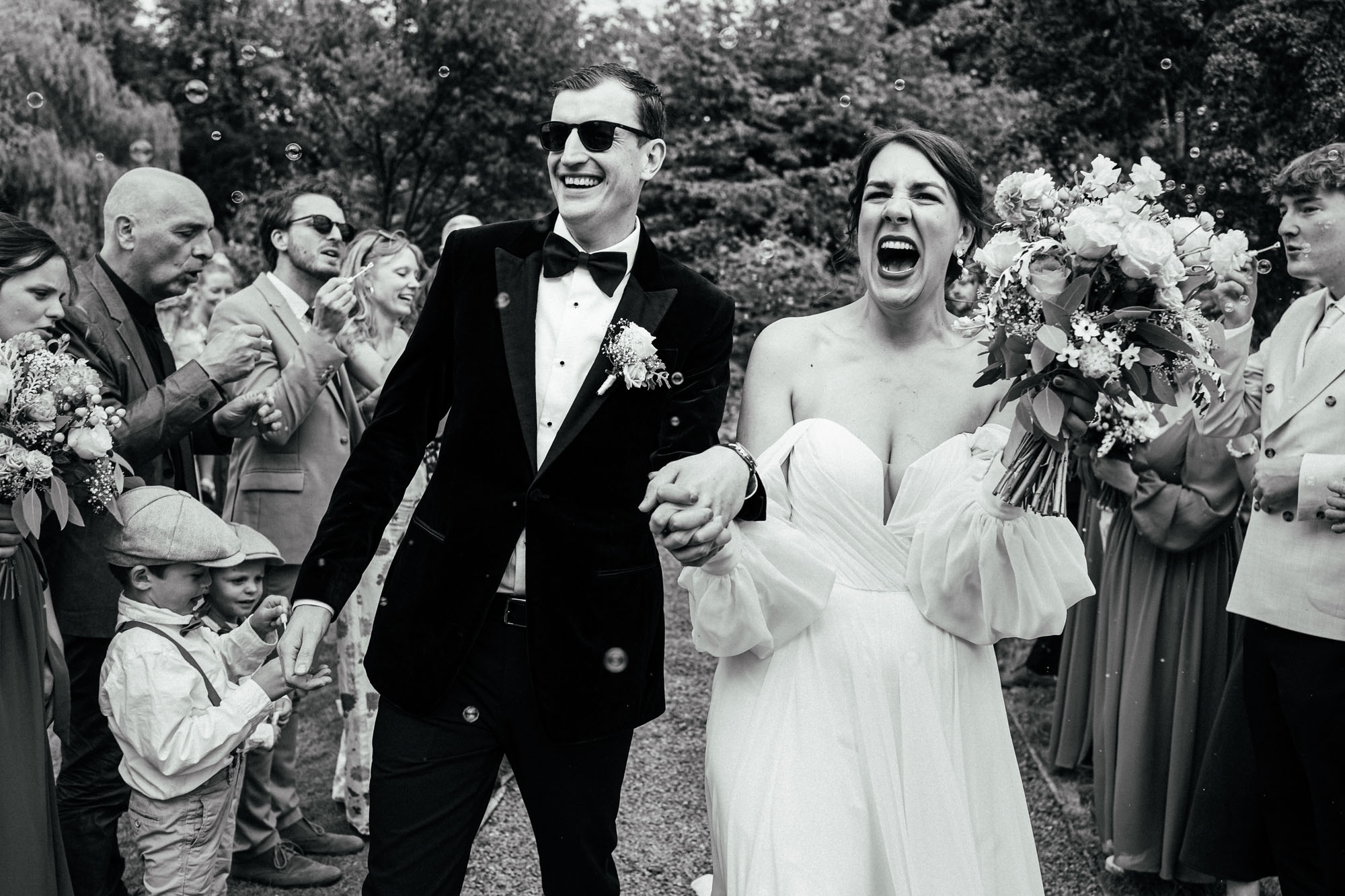
The images I’m proudest of are the ones that reward a second look. A tenth look. The ones where you notice the grandmother in the foreground before you clock the couple in the background. Where something makes you laugh on Tuesday that you didn’t see on Saturday. Where your mum spots herself in the corner and rings you up crying.
That only happens if the information is there to find.
You can’t compress a painting into a single brushstroke and then wonder why it doesn’t have any depth.
The most common thing my couples say when they get their photos back — and I mean this is genuinely the thing I hear more than anything else — is every time I look I see something new. That’s not a coincidence. That’s not luck. It’s because I made a choice at every single moment of your wedding day to keep the world in the frame rather than dissolve it into a soft haze behind your face.
So what am I actually arguing for?
Not messiness for its own sake. Not technical sloppiness dressed up as philosophy. I know how lenses work. I’ve studied lighting for years, sat through Joe McNally courses, read all the books. The choice to shoot at f/8 is just as deliberate as the choice to shoot at f/1.4. More deliberate, probably, because it’s harder — you can’t hide behind a blurred background if the blurred background isn’t there.
What I’m arguing for is honesty. The specific, unrepeatable, slightly-chaotic honesty of your actual wedding day, in an actual place, with actual people who are actually feeling things. The version that, in twenty years, takes you straight back. Not to a wedding. To yours.
Bokeh gives you something that looks like a wedding. I want to give you something that looks like your wedding.
The adjectives stay in.
.
Tired of seeing the same old wedding photos?
My couples tell me things like “We didn’t know you were there“, “The photos are totally us” and “Everytime we look through the photos we see something new”.
That stems from an intentional interaction with a wedding – sensitive to preserving the heart of it, but capturing the story, the atmosphere, the emotions and your people in multilayered photos that take you back to the beating heart of the day.
If you want that sort of magic from your wedding photography – download the brochure, get in touch and let’s start talking about what I can create for you.
